The full dossier from this story is free to read: download the PDF (43 pages), open it as a web page, or take the plain text. The computation that tested it is further down, with its charts and data.
The Question at the Kitchen Table
It was a Sunday evening near the end of September, the kind of evening when the light goes out of the sky early and nobody minds. The camper sat at the edge of the yard on its blocks, dark, still waiting on its trip back to the repair shop. The steward sat at the kitchen table with a cup of something warm and typed a question into the research helper.
It was a big question, and a slightly foolish one, the kind you ask when you are tired and the mind wanders. How would you turn a small pull-behind camper into a listening house? A place on wheels that could hear the whole sky: the weather stations and the aircraft, the fire crews and the ham operators, the satellites going over, the far voices on the long bands at night. A radio room you could tow.
The helper is a patient thing. It does not laugh at a question. It went away and read, the way it does, pulling in some hundreds of pages from all over, and it came back in about twenty-six minutes with a report. Then it read its own report, decided three corners of it were thin, and sent three smaller helpers out to fill them: one on clean power and grounding, one on keeping your own transmitters from deafening your own receivers, one on the software that turns radio hiss into words.
When it was all stitched together it came to about forty pages. Ten chapters, a pile of diagrams, a hardware table, a legal chapter, and a checklist for setting up in a field.
The steward read it the next morning with his coffee, and laughed out loud more than once. Not because it was wrong. Because it was so very much.
         THE LISTENING HOUSE  .  THE MORNING MEASURE
  +----------------------------------------------------------+
  |  Sunrise / Sunset ..... about 07:03  /  about 18:53      |
  |  Photoperiod .......... about 11h 50m, and shrinking     |
  |  Moon ................. Waning gibbous                   |
  |  Morning .............. fog, then dry and mild           |
  |  Pages in the dossier . about forty                      |
  |  Jobs on the cluster .. two tries, one good answer       |
  |  Gap that matters ..... one hand's width                 |
  +----------------------------+-----------------------------+
                               |
              +----------------+----------------+
              v                                 v
     ANSUZ . THE SIGNAL               ALGIZ . THE WARD
     Listen well, and know            A shield is only a
     what you heard.                  shield where it is whole.
Chapter 1: What the Machine Brought Back
The dossier does not think small. It wants the whole shell of the camper lined like a tin can, three coats of paint with nickel and copper in it, then a layer of metal-plated cloth over that, every seam overlapped and taped. It wants bronze screen in the windows and springy metal fingers around the door. It wants the cooling air to come in through little honeycomb vents that let wind through and keep radio out. It wants the computers riding on steel-cable springs so the washboard roads do not shake the solder loose.
It wants a battery bank the size of a chest freezer, chosen not for how much it holds but for how quiet it is. This was one of the parts the steward liked best. Nearly every modern power gadget, the solar controllers and inverters and battery managers, works by switching current on and off many thousands of times a second. That switching sings. You cannot hear it, but a radio can, and on the long bands it sounds like frying bacon laid over everything you are trying to hear. So the dossier wants the quiet kind of everything, and chokes and filters on every wire that leaves a box, and one single point where every ground in the camper meets, so no stray current can go looping around the walls.
Then it wants a mast that pushes antennas up above the trees, a ring of five small antennas that can tell which way a signal came from, receivers for every band from the long waves to the microwave, a rack of computers to listen to all of it at once, and a satellite dish and a cell router so it can all talk home.
It is a beautiful document. It is also, for a small household on a ridge, roughly like asking how to grow a tomato and being handed the plans for a greenhouse the size of a barn.
That is not a complaint. A good answer to a big question should be big. The trick, the same as with any large book of advice, is knowing which three pages you actually need.
Chapter 2: The Watchman Who Could Hear the Grass
The old stories have a patron for a house like this.
Heimdall keeps watch at the end of the rainbow bridge, where the gods’ world meets the rest. The lore says he needs less sleep than a bird. He can see a hundred leagues by night as well as by day. And his hearing is so keen that he can hear the grass growing in the fields and the wool growing on the sheep. He holds the horn that will sound when the end of things comes over the bridge, and until then he listens.
What the stories do not say, and what anyone who has sat up late with a radio knows, is that most of listening is not hearing. It is sorting. The sky is full of noise. The grass is always growing, and the wool, and the wind in the wires, and the neighbor’s fence charger ticking, and a hundred machines humming to themselves. A watchman who could only hear would go mad by morning. What makes Heimdall a watchman and not just a pair of big ears is that he knows which sound matters.
The dossier understood this better than the steward expected. Half of its forty pages are not about hearing more. They are about hearing less: less of your own noise, less of your own transmitter, less of the frying bacon from your own batteries. Quiet first. Then listen.
Chapter 3: Listen, and Do Not Tell
The legal chapter of the dossier is the one every reader should read twice, and the one we most wanted to put at the front.
In this country, as in most, you may listen to the open air. Weather, aircraft, ships, ham operators, open public-safety dispatch, the satellites that broadcast for anyone: all of that may be heard. What the law draws hard lines around is anything scrambled or encrypted, anything on the phone networks, and anything you might do with what you heard. You may listen to a dispatcher for your own awareness. You may not publish what you heard, or use it for gain. Breaking a code to hear something that was locked is not listening at all; the law treats it as breaking into a house.
The dossier is careful and plain about all of this, and it ends that chapter with a short list of house rules for staying on the right side of it: receive only, never decode anything locked, do not keep logs of other people’s business, and know the rules of each state you tow through, because some of them care a great deal about a radio in a moving vehicle.
The old wisdom got there first. The Havamal, the sayings of the High One, has a verse about the careful guest who comes to a feast. He keeps quiet, it says, and listens with his ears and watches with his eyes, and that is how the wise man looks about him. The guest at the table hears everything. A good guest repeats almost none of it.
That is the whole ethic of a listening house, and it is older than radio. Hear widely. Speak rarely. Never pick a lock.
Chapter 4: Sending the Question to the Cluster
A report is only words, and the household has learned this autumn to be careful with words that sound certain. So the steward did the thing the research helper now allows: he asked it to test one of its own claims with a real computation.
The helper suggested one. How much does each candidate wall material actually block, across the radio bands, from the very long waves up to the microwave? Aluminum sheet, aluminum foil, copper sheet and copper foil, galvanized steel, stainless steel, the special magnetic alloy called mu-metal, the metal-plated cloth the dossier loves, and the thin metallized film people put on windows. And then the question that mattered most: what happens to all of them when there is a gap?
It wrote a small program, the steward read the plan and approved it, and it went off to the cluster at the day job, the big shared computer that runs other people’s science most of the time.
The first try never ran. The part of the cluster it asked for was full; the cloud behind it had simply run out of that kind of machine in that place for the morning. So the job was moved to a different kind of machine, and there it ran in thirty-two seconds. It computed nine materials at five hundred frequencies each, under three kinds of radio wave, and came back with four charts, a table, and a short note in plain language.
Chapter 5: The Numbers That Were Too Good
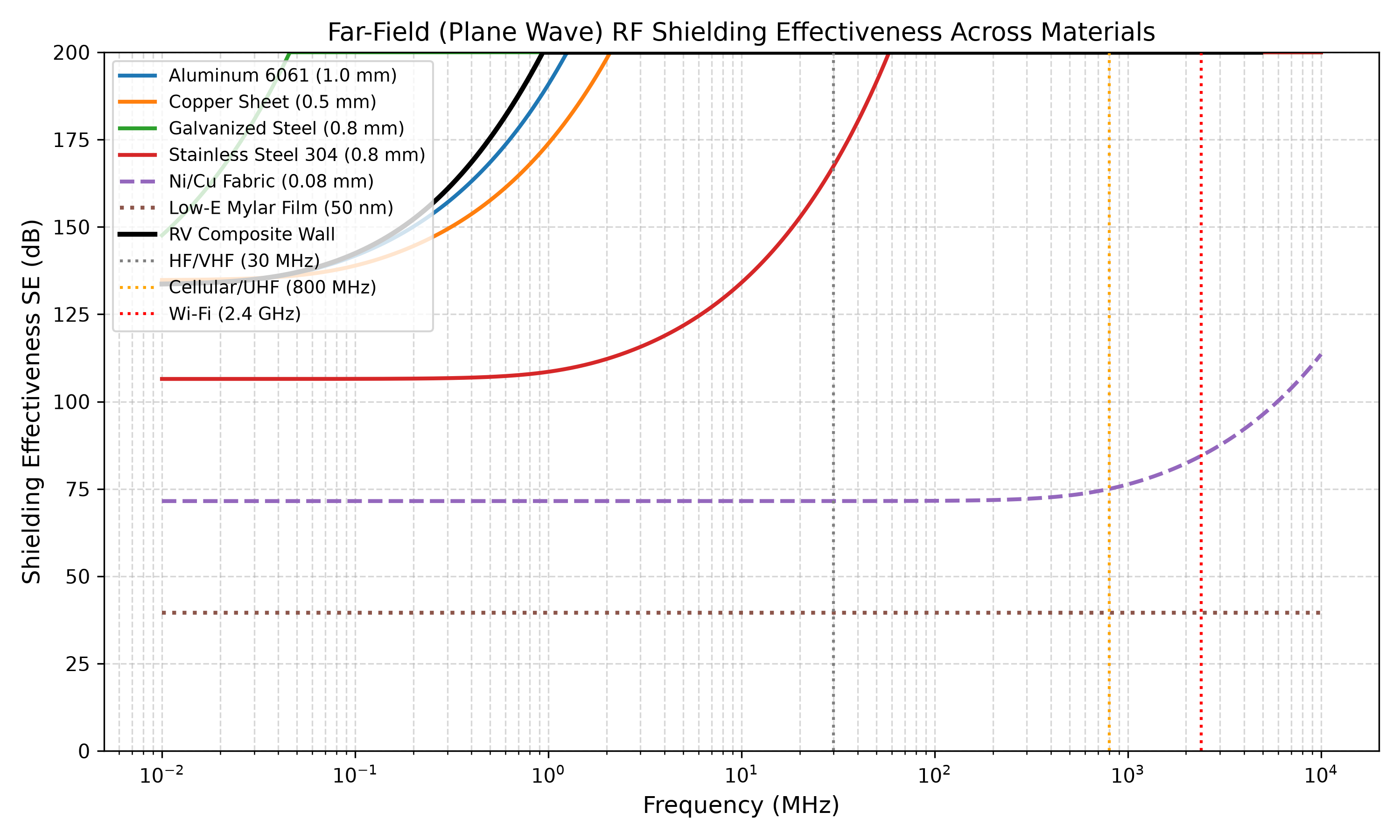
The first chart looked wonderful. It said a sheet of aluminum as thick as a coin blocks thousands of decibels at the higher bands. It said the magnetic alloy blocks tens of thousands.
Those numbers are not true, and the note that came back with them said so, which is the best thing about it.
A decibel is a ratio on a stepped scale. Every ten decibels is another factor of ten. Sixty decibels means a millionth of the signal gets through. A hundred means one part in ten billion. Real test equipment runs out of room somewhere around a hundred to a hundred and forty; past that, there is nothing left to measure, and what gets through a real box is set by its seams and corners and the shape of its insides, not by the metal. A number like two thousand five hundred decibels is not a measurement. It is the arithmetic running off the edge of the page. The program’s own log even complained, in its dry way, that its numbers had overflowed.
The note also admitted a second fault: it had treated the magnetic alloy as though it kept its special power at every frequency, when in truth that power fades fast above the low bands. So the alloy’s grand high-frequency numbers were wrong twice over.
Here the household remembered a lesson from earlier this autumn, when the ridge’s own dashboard was found printing numbers that nothing had measured. A number that is too steady, or too grand, deserves a second look. The honest reading of this chart is short: every solid metal sheet, even kitchen foil, blocks more than anyone could ever measure. The cloth and the window film block a good deal less, but still a lot. For a camper, material is not the problem.
The next chart shows what is.
Chapter 6: One Hand’s Width
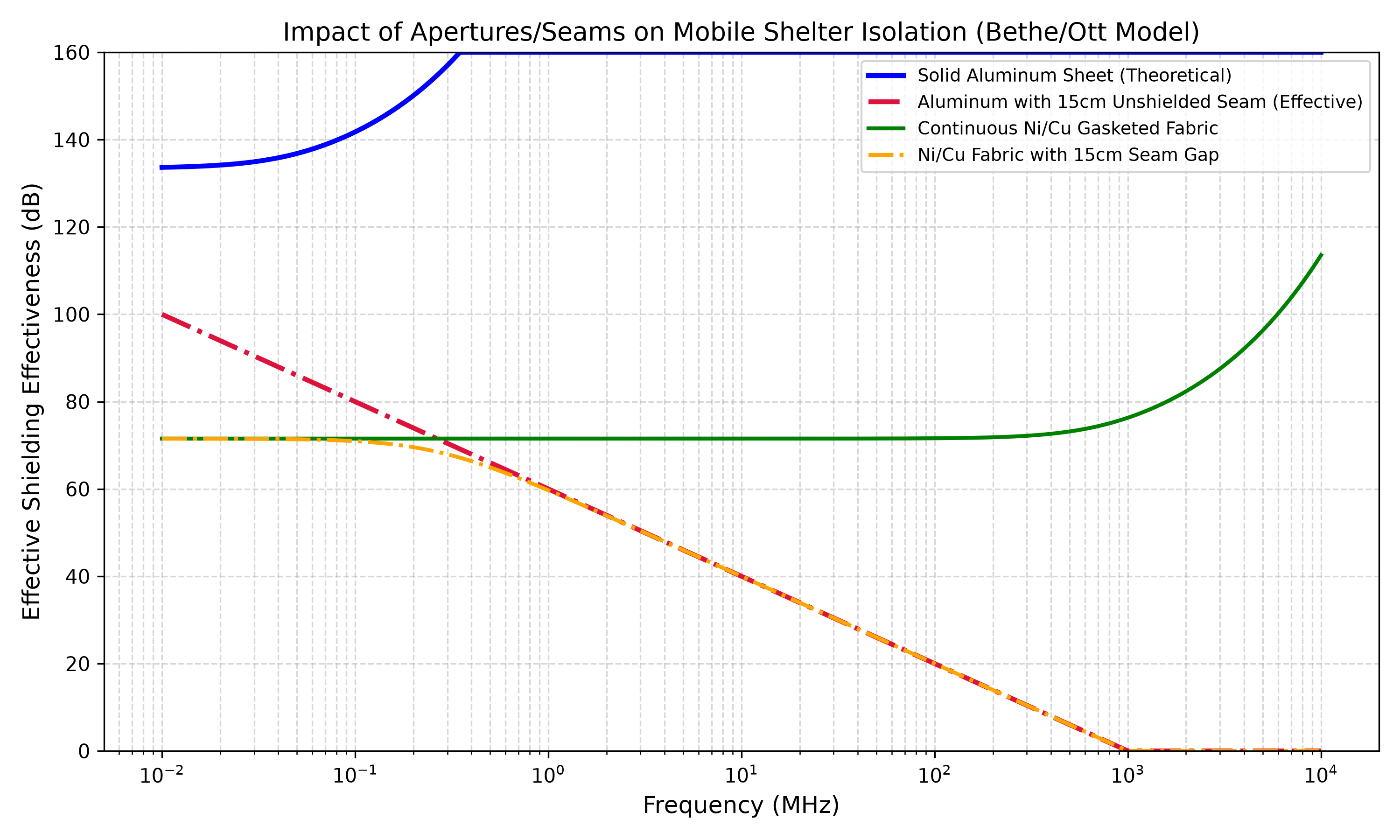
The last question the program asked was simple. Take each material, perfect as it is, and cut one slot in it fifteen centimeters long, about the width of a hand. A vent left open, a window with no screen, a seam where the tape let go.
At the band where much of the everyday radio world lives, around eight hundred megahertz, every single material dropped to about two decibels of shielding.
Two. Not two thousand. Two. Two decibels means that most of the signal walks right through. The coin-thick aluminum, the copper, the steel, the fancy alloy, the plated cloth: with one hand-sized gap, they all perform exactly alike, which is to say barely at all. The chart shows every material’s line standing tall, and then falling together into the same ditch the moment the slot appears.
This is a lesson the ridge already knew in other clothes. A fence is not as strong as its best post; it is as strong as the gate somebody left on the latch. A coop is only as safe as the one gap under the door the fox can fit his nose in. The storm door does nothing if the window beside it is open. We wrote a whole small book this month about how every gate has a neighbor, and here the same truth came back from the cluster as a chart.
The dossier, to its credit, had said as much in its own words: a shield is ruled by its biggest opening. But it is one thing to read that sentence and another to watch nine lines fall into one ditch.
So if the traveling house ever does become a listening house, the money and the Saturdays will not go into thicker metal. They will go into the boring parts. Overlapped seams. Door gaskets. Screens on the windows. Honeycomb vents. A careful walk around the whole shell with a small receiver, looking for the one place the tape let go.
Chapter 7: What the Traveling House Will Actually Get
It is worth saying plainly: the camper is not going to become a signals intelligence platform. It is going to become, perhaps, a slightly better radio shack for the weeks it is parked somewhere quiet.
From the forty pages, the household has kept about three.
The quiet power. A good battery and a quiet charger, ferrite rings on the cables, and one grounding point instead of five. That alone will make the long bands at night sound less like a frying pan.
The listening, not the lock-picking. A couple of small receivers and a laptop, tuned to the weather, the aircraft, the satellites, and the ham bands. Nothing encrypted, nothing on the phone networks, nothing logged about anybody.
And the crack in the wall. If we ever shield anything, even one box, the seams get sealed first.
The rest of the dossier we are publishing whole, for anyone who wants to read how far the idea can be pushed. It is a good read, and a good reference, and a fine example of a machine answering a big question with its whole heart. It is also a reminder that the answer to a big question is not the same as the plan for a small household.
Troth: The Rules of the Listening House
- Quiet first. Hunt down your own noise before you try to hear anyone else.
- The wall is as good as its smallest gap. Seal seams before you buy thicker metal.
- Listen to the open air only. Never break a lock, never touch the phone networks.
- What you hear is not yours to tell. Hear widely, speak rarely.
- A number too grand to measure is not a measurement. Read the limits before the results.
- When the machine gives you forty pages, find the three you need, and keep the rest on the shelf.
- Test the claim before you trust it, and say plainly what the test could not show.
What Still Sits on the Scale
The note from the cluster asked for a second run, a better one, with the magnetic alloy allowed to lose its power at higher frequencies the way it really does, and with proper honeycomb vents instead of a bare slot. That run has not been sent. It will cost almost nothing, and it may come one of these evenings.
The camper is still waiting to go back to the shop for its other troubles. It will be a while before anyone lines its walls with anything.
And three of the smaller reports the helper wrote seem to have been saved only in part; the tails are there, the heads are missing. The main report is whole, and that is what we published. The rest is on the list.
The Blessing
Hail Heimdall, the watchman at the bridge, who hears the grass grow and knows which sound matters.
Hail the High One, who taught the careful guest to listen with his ears and watch with his eyes, and keep his tongue.
Hail to the land-wights of this ridge, who have heard every wind that ever crossed it, and never told a soul.
May our own noise be quiet, so that we can hear the far voices. May every seam be sealed, and every gate be latched. May we hear widely, and speak only what is ours to say. May every number we are given be one somebody measured. May the traveling house come home mended, and sit easy on its blocks. May the long bands be clear on the cold nights, and the satellites pass overhead on time.
The fog lifts off the ridge. The moon wanes in the west. The dark half deepens. Quiet the house. Seal the gap. Listen.
Wes hal.
ᚨ ᛉ ᚺ
The Files
Everything from this story, free to download:
- The dossier: PDF, 43 pages . web page . plain text (Markdown). The main report plus its three supplements, exported as written by the research helper, with its source list.
- The computation: results note . shielding by band (CSV) . the job script . the plan
- The charts: far field . near field, magnetic . absorption and reflection . with and without a gap


A reader’s note: the dossier and the computation are machine work, published as they came back. The dossier’s source links point through a search service and may stop working in time; the site names beside them still tell you where each claim came from. Shielding values in the computation above about a hundred and forty decibels are beyond anything that can be measured, as explained in Chapter 5. Read the legal chapter, and follow it.